Why Boring Technology Wins
The newest framework is always the most exciting and almost never the wisest choice. Boring, well-understood technology wins over time because its costs are known, its edges are mapped, and its surprises are few.
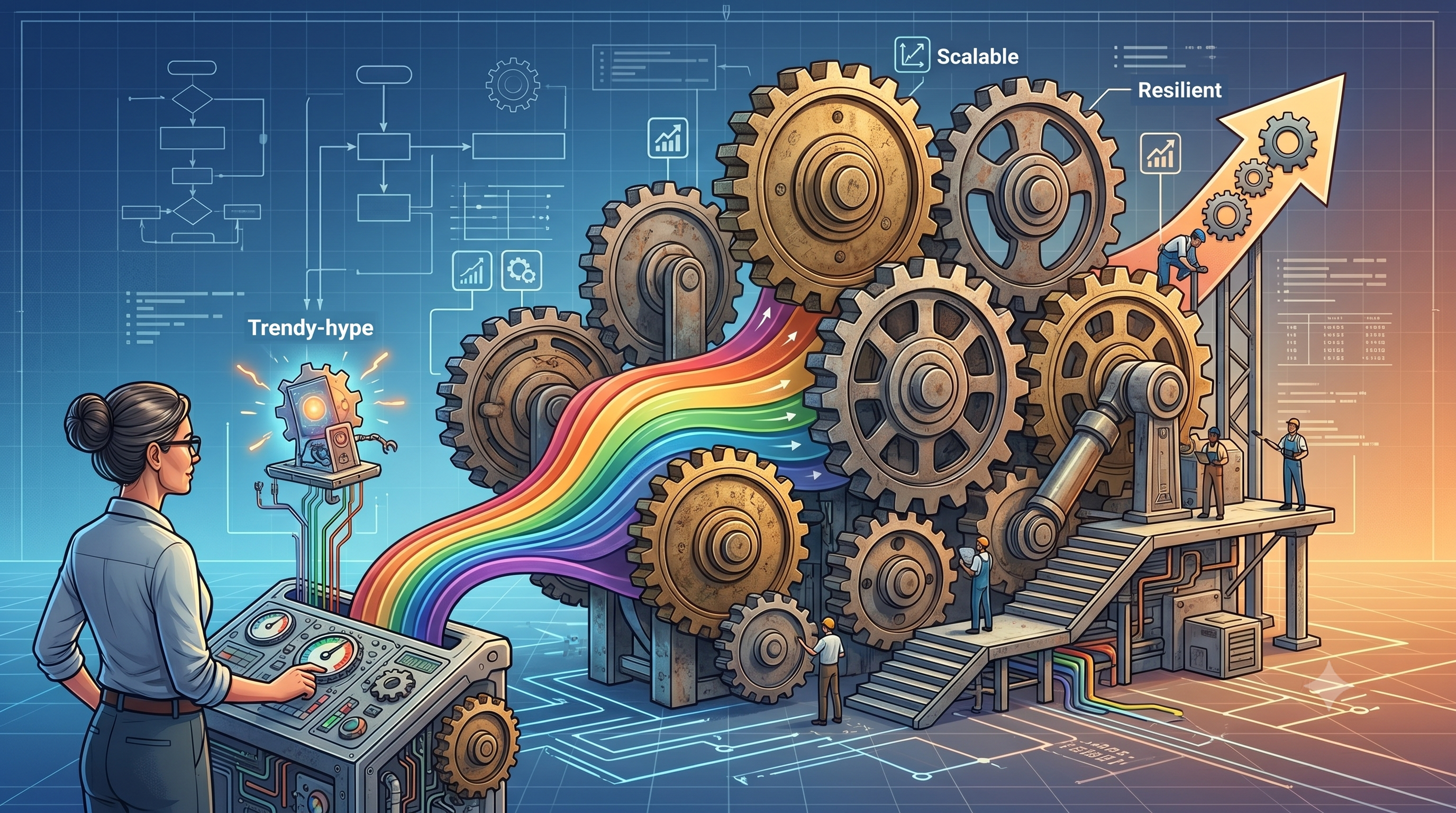
There is a particular thrill in adopting the newest thing — the framework announced last month, the database everyone is suddenly talking about, the language feature that promises to change everything. The thrill is real, and it is also a trap. Over and over, the teams that ship reliable software for years are not the ones chasing the frontier; they are the ones who chose boring, well-understood tools and spent their excitement on the product instead.
The appeal of the new
It is worth being honest about why new technology is so seductive. Part of it is genuine: new tools sometimes solve real problems the old ones could not. But a large part is psychological. The new is interesting; the familiar is dull. Learning a shiny framework feels like growth, while using the one you already know feels like standing still. And there is status in being early — in being the person who knew about the thing before it was popular.
None of these motives is shameful, but none of them is about shipping good software either. They are about how the work makes us feel, and a tool chosen because it is exciting to use is not the same as a tool chosen because it is the right foundation. Confusing the two is one of the most common and expensive mistakes in our field.
What "boring" actually means
Boring technology is not bad or outdated technology. It is technology whose behavior is thoroughly known. Its failure modes have been discovered by thousands of people before you. Its rough edges are documented, its performance characteristics are understood, and the answer to almost any question you will have already exists in a forum post from three years ago. Boring means predictable, and predictable is precisely what you want underneath something you are trying to keep running.
New technology, by contrast, is mostly unknown. Not necessarily worse — sometimes genuinely better — but unknown. You will be among the first to hit its bugs, with no one ahead of you to have written down the fix. You will discover its limitations the hard way, in production, at the worst possible time. The newness that feels like an advantage is, from the perspective of risk, a long list of surprises you have not encountered yet.
The hidden costs of novelty
Every new tool carries costs that are easy to overlook in the excitement of adoption. There is the learning curve, paid not once but by every person who joins the team. There is the immaturity of the surrounding ecosystem — the missing integrations, the thin documentation, the libraries that do not exist yet. And there is the maintenance burden of being early, of upgrading through breaking changes while the tool finds its footing.
- Every team member must learn the new thing, not just the person who chose it.
- Early ecosystems lack the libraries, integrations, and answers that make work fast.
- Breaking changes are frequent while a young tool is still finding its shape.
- When something goes wrong, you may be the first person to have seen the problem.
These costs are real but deferred, which is why they are so easy to ignore at decision time. The excitement is immediate and concentrated; the costs are spread across months and shouldered by people who were not in the room when the choice was made. That asymmetry is exactly how teams talk themselves into novelty they later regret.
Choose technology for the problems you will not have, not the excitement you will feel.
Spending your novelty wisely
A useful way to think about this is that a team has a small, fixed budget for novelty — a few risks it can afford to take before the accumulated unknowns overwhelm its capacity to ship. Spend that budget on the parts of the system where being new actually buys you something: the genuinely hard problem at the heart of your product, the place where an off-the-shelf answer truly does not exist.
Everywhere else, spend nothing. Use the boring database, the boring language, the boring deployment setup that thousands of teams have already debugged for you. The goal is to concentrate your unknowns in the one or two places where they might pay off, and to make everything around them as predictable as possible, so that when something breaks you know it is the interesting part and not the plumbing.
When new is the right call
This is not an argument for never adopting anything new — that path leads to its own slow obsolescence. New technology is the right call when it solves a problem you actually have, when its benefits clearly outweigh the cost of its unknowns, and when you have the budget of attention to absorb the surprises it will bring. The point is to make that choice deliberately, weighing the deferred costs, rather than reaching for the new thing because it is new.
The discipline, in the end, is emotional more than technical: to notice the thrill of the new and to not mistake it for a reason. The best engineers are not the ones who use the most advanced tools. They are the ones who can tell the difference between a tool that excites them and a tool that is right, and who have the patience to choose boring almost every time.