The Real Cost of Distraction
A glance at a notification costs you a few seconds, or so it seems. The real bill arrives later, in the minutes it takes to find your way back into the thought you were having — and most of us never see it.

A notification arrives. You glance at it, decide it can wait, and return to your work. The whole detour took maybe five seconds, and five seconds is nothing. Except that the real cost of distraction is almost never the few seconds of the interruption itself. It is the long, invisible climb back to where you were — the rebuilding of a mental state that took effort to construct and collapsed the instant your attention left it.
Distraction is not just lost time
We tend to account for distraction in the wrong currency. We measure the interruption — the glance, the quick reply, the thirty seconds on another tab — and conclude that the cost was small. But the interruption is the cheap part. The expensive part is what it does to the work you were doing, which does not simply pause and resume but partially dissolves and has to be reassembled.
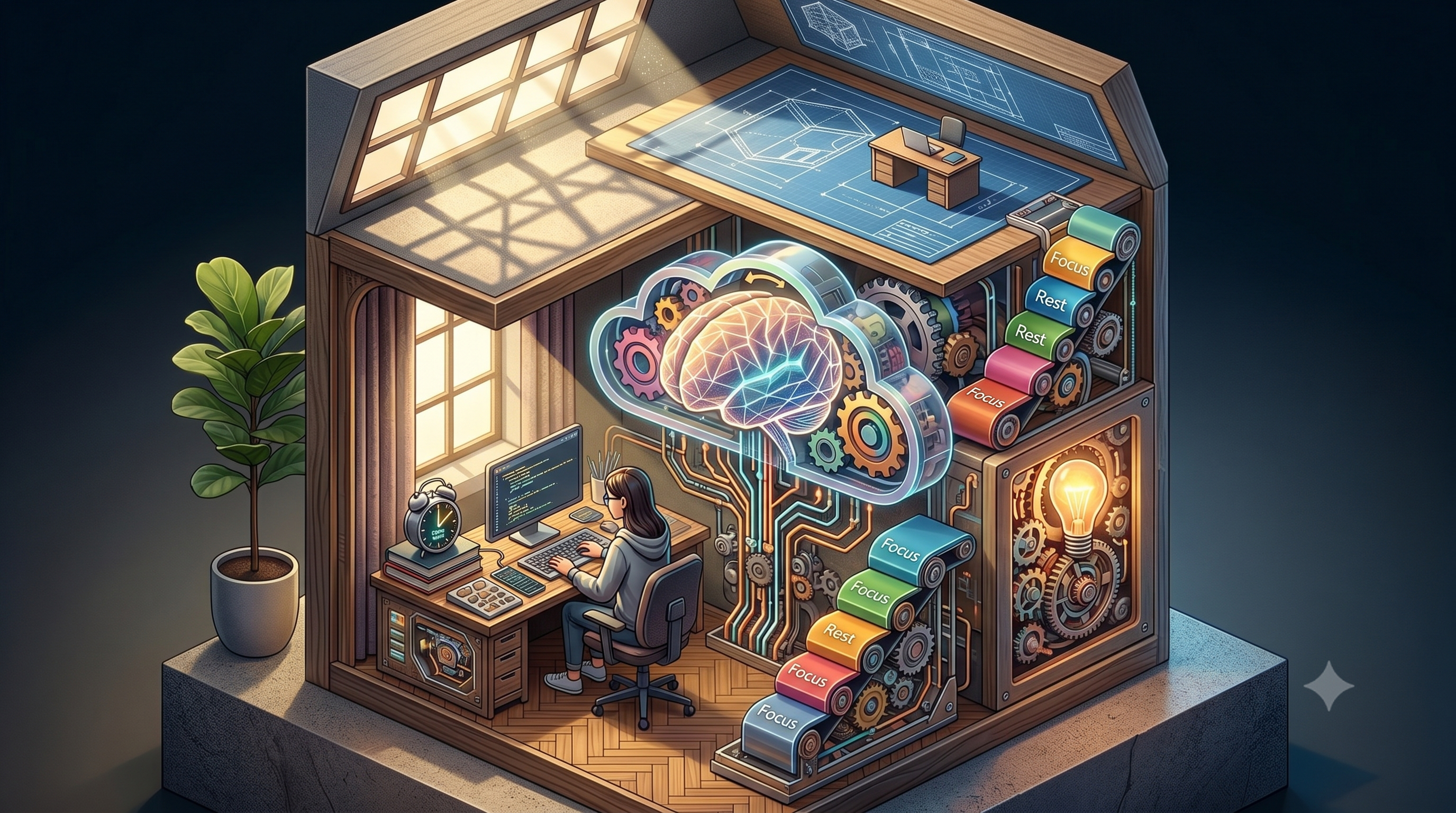
Complex work happens inside a mental model you build up in your head: the variables you are holding, the shape of the problem, the half-formed solution you were reaching toward. That model is fragile, and it does not survive your attention leaving it. When you come back, you are not resuming; you are rebuilding, and the rebuild is where the real time goes.
Attention residue
There is a further, subtler cost. When you switch from one task to another, a part of your attention stays behind, still tangled in the thing you just left. Researchers who study attention call this residue, and it means that after an interruption you are not only behind on the new task — you are also working at reduced capacity, because some of your mind is still elsewhere.
This is why a day full of small interruptions can feel exhausting even when little got done. You were never fully present for any single thing. Each switch left a trail of unfinished attention behind it, and you spent the day operating at a fraction of your real capacity while feeling busy the entire time. The fatigue is real; the output is not, and the gap between the two is the cost no one billed you for directly.
The myth of multitasking
The comforting story we tell ourselves is that we can do several things at once. We cannot. What feels like multitasking is rapid switching, and switching is expensive every single time. The mind does not run parallel threads of focused thought; it runs one, and "multitasking" is just the experience of moving that single thread back and forth quickly enough to feel simultaneous.
Each of those moves carries the switching cost and leaves its residue. So the person who feels most productive — phone in hand, three chats open, jumping between tasks — is often the one getting the least real work done, while paying the highest attentional tax. The feeling of busyness and the reality of progress have quietly come apart.
The interruption costs you seconds. Finding your way back into the thought costs you the afternoon.
The environment is the problem
It would be comforting to frame this as a failure of willpower, but it is mostly a failure of environment. We work inside tools engineered to interrupt us — designed, with great skill and large budgets, to capture attention and pull it away. Against that, individual discipline is a weak defense. You will lose a willpower contest against a system built by thousands of people to win it.
The realistic move is not to try harder but to change the environment so that distraction has to work to reach you. Silence notifications by default. Close the channels you are not actively using. Put the phone out of arm''s reach. None of this is dramatic, and that is the point: distraction thrives on frictionless access, and the cure is to reintroduce a little friction between you and everything that wants your attention.
- Default notifications to off, and turn on only what genuinely needs you.
- Close idle tabs and chats; an open channel is a standing invitation to switch.
- Put the phone somewhere you have to stand up to reach.
- Protect blocks of time where interruption is structurally impossible, not merely discouraged.
Reclaiming depth
The reward for defending your attention is not just more output, though there is more. It is the return of a quality of work that constant interruption makes impossible — the deep, absorbed state where hard problems actually get solved and where the work stops feeling like a fight. That state takes time to enter and is destroyed in an instant, which is why it has become rare, and why protecting the conditions for it matters so much.
Depth is also where the satisfaction lives. The scattered day leaves you tired and vaguely dissatisfied, with the sense of having been everywhere and nowhere. The focused day, even when it produced less by raw count, leaves you with the rare and grounding feeling of having actually been present for your own work. That feeling is worth defending, and it is exactly what distraction quietly takes.
Paying attention to attention
Start by simply noticing the real cost — not the seconds of the interruption, but the minutes of the climb back, and the residue that lingers after. Once you can see the true price, the trades become obvious: a quieter environment, fewer open channels, protected time. You are not trying to eliminate every distraction, only to stop paying its hidden bill all day long without ever seeing the charge.